# The decision, in one line
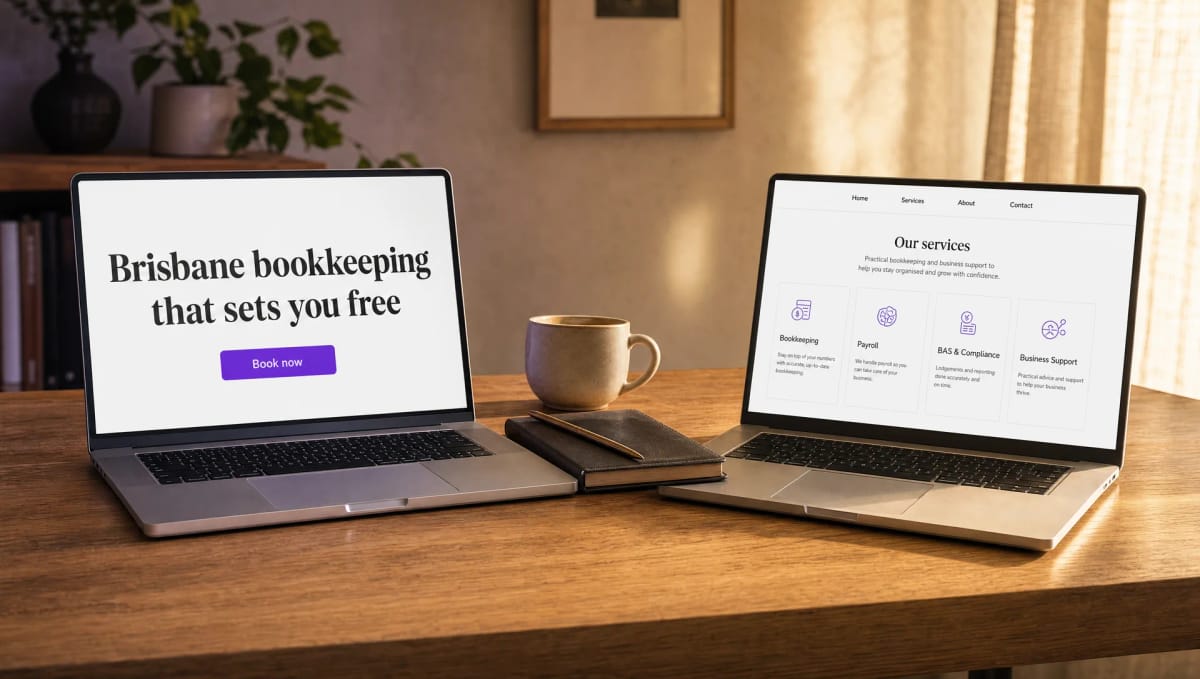
Choose one page if you sell one clear outcome and people buy it without much research; choose multi-page if you have distinct service lines, multiple locations, or buyers who compare several pages before deciding. Everything else in this guide is detail on that single rule. The mistake isn't picking wrong - it's picking by default, copying whatever the last agency built.
This matters because page structure shapes two things at once: how a visitor converts, and how Google ranks you. Get the structure wrong and you fight both. A sprawling multi-page site for a one-offer tradie buries the phone number behind a menu; a single endless page for a five-practice law firm gives Google nothing specific to rank. The structure should match the buying journey, not a rule of thumb or a template.
The rest of this piece is the decision framework - what each model actually is, the five questions that decide it, the SEO angle most buyers miss, and how to choose by business type. For the delivery mechanics of a one-page build specifically, see how one-day website builds actually work; for what each costs, see what a website costs in Australia in 2026.
The one-page versus multi-page question is really a buying-journey question in disguise. Count the distinct decisions a customer makes before they enquire. One decision means one page. Several genuinely separate decisions - different services, different locations, different proof - means several pages, one per decision.
# What a one-page site actually is (and when it converts best)
A one-page site is a single scrolling page that takes a visitor from headline to conversion without a navigation menu - every section builds toward one action. Done well, it's the highest-converting format for a single-offer business because it removes choice: there's nowhere to wander, no menu to get lost in, one clear next step.
The conversion logic is grounded in how people actually read web pages. Nielsen Norman Group's research shows users scan rather than read, and that a focused, linear page with a clear visual hierarchy outperforms a maze of options when the goal is a single action. Mobile reinforces this - with the majority of Australian web traffic on mobile, a one-thumb scroll to a tap-to-call button beats a hamburger menu hiding five pages.
A one-page site converts best when: you have a single offer (a booking, a quote, a consultation); your prospect can decide in one visit without comparing service lines; and your value is easy to convey in a single narrative. That describes most tradies, solo practitioners, single-location clinics, and local service businesses. CalnetCorp's Website in a Day ($2,499) is built exactly for this shape - if it's clearly your profile, you can start a Website in a Day build ($2,499, $0 today) without a multi-page scoping call.
# What a multi-page site actually is (and when you genuinely need it)
A multi-page site splits content across distinct URLs - home, service pages, about, contact - each one able to rank and convert independently. The value isn't "more pages"; it's that each distinct thing you sell gets its own focused page, its own keyword target, and its own conversion path. For the right business, that's a structural advantage a one-page site cannot match.
The clearest signal you need multi-page is distinct service lines. A law firm doing family, property, and commercial law has three different buyers searching three different terms - collapsing them onto one page serves none of them well. The same applies to a multi-service trade, a clinic with several treatment categories, or a B2B firm with separate products. Each deserves a page that ranks for its own intent and speaks to its own buyer.
The second signal is multiple locations. A business serving Brisbane, Logan, and Ipswich benefits from a page per area, because local search rewards location-specific pages with location-specific content. The third is buyer research depth: in considered purchases, buyers genuinely want an About, a Services breakdown, and proof before they enquire - and Nielsen Norman Group's navigation research shows clear multi-page navigation helps those buyers self-orient. CalnetCorp's Multi-Page Website ($2,999 + $99/mo, up to five pages, $299 per extra page) exists for this profile - it's a call-required scope because the page architecture is the work.
# The five-question decision framework
Five questions decide it. Answer "yes" to two or more of the multi-page signals and you need multi-page; otherwise one page will convert and rank better for less. This is the framework we walk every CalnetCorp prospect through before quoting either build.
Source: CalnetCorp scoping framework applied across 2026 H1 builds; SEO-intent logic per Google Search Central's SEO starter guide.
The framework resists the default. Most businesses, asked cold, assume "more pages = more professional" - but the Australian Bureau of Statistics shows the majority of small businesses use their site as a primary customer touchpoint, where conversion clarity beats page count. Answer the five honestly and the right structure is usually obvious.
# The SEO angle most buyers miss
Google ranks pages, not websites - so the number of distinct keywords you need to rank for is the single most decisive SEO factor in the one-page versus multi-page choice. A one-page site concentrates all its ranking authority on one URL, which is powerful for one tight topic and structurally limited for many.
Per Google Search Central, each page should target a clear topic, and Google returns the single most relevant page for a query. If your goal is to rank for "emergency electrician Brisbane" and nothing else, one page does it well - all your internal links, content, and authority point at one target. But if you also want "switchboard upgrades Brisbane", "EV charger installation Brisbane", and "electrical safety inspection Brisbane", you're asking one page to be the best answer for four distinct intents, which it rarely can be. Ahrefs' research on keyword targeting shows that distinct intents perform best on distinct, dedicated pages.
This is the real multi-page argument, and it's an SEO argument, not a design one. The flip side matters too: thin, duplicative pages hurt. Five near-identical service pages with 100 words each are worse than one strong page - page count only helps when each page is genuinely distinct and substantive. For the full ranking-preservation picture when rebuilding, the Web Design pillar covers migration risk in depth.
The SEO test is simple: list the distinct search terms you need to rank for, where each represents a different buyer intent. One term means one page is enough. Five genuinely different terms means five pages, because Google will only ever rank a single page as the best answer for each query.
# Does page count actually change conversion?
Page count itself doesn't change conversion - friction and message-match do, and each model reduces a different kind of friction. A one-page site removes navigation friction; a multi-page site removes relevance friction for buyers who need to find their specific service. Picking the wrong one adds friction rather than removing it.
The mechanics are well-documented. Page speed is a conversion factor regardless of structure - Google's Core Web Vitals guidance and Cloudflare's performance research both tie slower loads to lost conversions, and a bloated multi-page site with heavy templates can be slower than a lean single page. But structure matters too: forcing a researching buyer through a single endless page, or forcing a ready-to-book customer through a five-click menu, both add friction.
Source: CalnetCorp conversion observations across client builds, aligned with Nielsen Norman Group scanning-behaviour research.
The honest takeaway: there's no universal "converts better" winner. There's only "converts better for this buyer, on this offer". Diagnose your buyer first, then pick the structure that removes their specific friction.
# How to choose by business type
Most Australian service businesses fall into a recognisable pattern, and the right structure usually follows from the business type. These aren't rules - run the five-question framework to confirm - but they're the starting points that hold for the majority of businesses we build for.
One page is usually right for: tradies with a single core service (emergency plumbing, residential electrical), solo practitioners (a single allied-health clinician, a sole-trader consultant), single-location cafes or studios, and any business whose entire pitch is "call us for this one thing". The Brisbane tradies profile is the textbook one-page case.
Multi-page is usually right for: law firms with distinct practice areas, multi-service trades (a builder doing renovations, extensions, and new builds as separate lines), clinics with several treatment categories, multi-location businesses, and B2B firms with distinct products or audiences. If you're a professional-services firm whose buyers expect to read about your team and approach before enquiring, multi-page earns its keep.
Start one-page, extend later suits businesses unsure which service lines will earn their own page. Launch one strong page, get it converting and ranking, then add service pages as you validate demand. This only works cleanly if you own your code - which the Brisbane web designer buyer's guide explains is non-negotiable when choosing any provider. If you'd rather talk it through, book a 20-minute call and we'll run the framework on your specific business.
# How CalnetCorp does both - and helps you pick
CalnetCorp builds both, deliberately priced close together so the choice is about fit, not cost: Website in a Day at $2,499 for one page, Multi-Page Website at $2,999 plus $99/month for up to five. The $500 gap is intentional - we don't want price nudging you toward the wrong structure for your business.
The one-page Website in a Day is $2,499 flat, $0 charged today, billed only on approval, with year one of hosting and lead routing included. The Multi-Page Website is $2,999 plus $99/month, up to five pages in three business days, $299 per extra page, call-required because the page architecture is the work we scope together. Both ship with the same lead infrastructure - email plus SMS routing, schema markup, GA4 and Meta tracking - and full code ownership from day one.
If the five-question framework points clearly to one page, you can start a Website in a Day build directly ($0 today, billed on approval). If it points to multi-page, the multi-page guide is the right next step. If you're genuinely unsure, that's exactly what a 20-minute call is for - and if you also want to know whether AI search engines can currently see your business, the free AI visibility audit comes back in 48 hours.